Part 1 of 2. Part 2 is here.
UPDATE: Weeks after this was written, on Aug. 22, 2023, PM Kishida announced that, weather permitting, the releases would begin two days later, on Aug.24. They did.
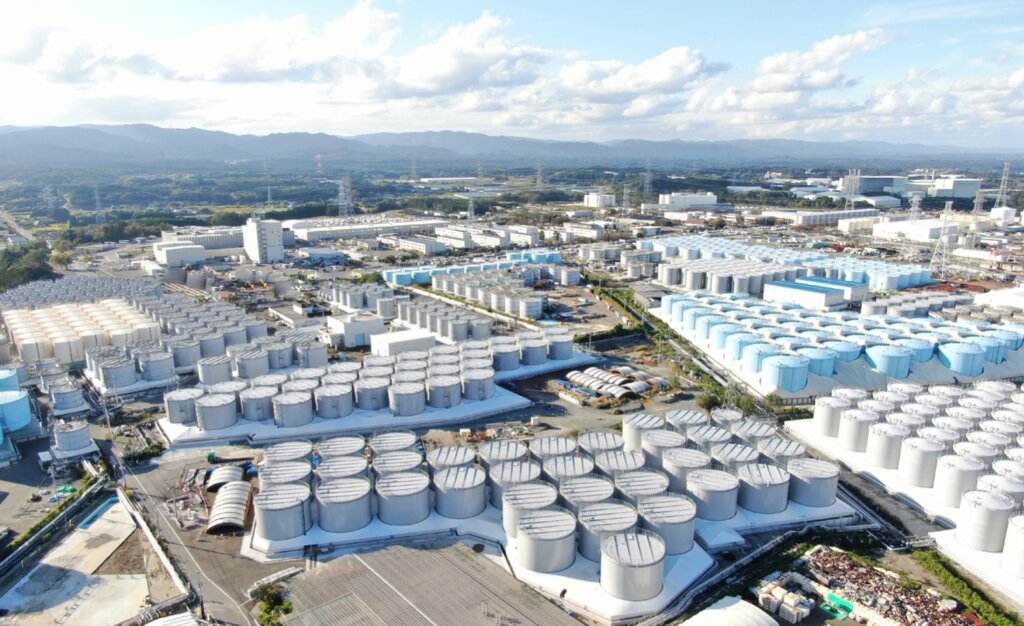
As this is being written on August 2, 2023, no date has yet been announced for the start of the planned release of contaminated water currently being stored in tanks at the Fukushima Daiichi Nuclear Powerplant (FDNPP). For months, Japanese government sources and TEPCO have said they hoped the releases would begin this summer. IAEA Director General Rafael Mariano Grossi hand-delivered his agency’s supportive final report on the release plan to Japanese Prime Minister Kishida on July 4th of this year. Japan’s Nuclear Regulation Authority (NRA) issued its approval days later. Reports from past weeks indicate that TEPCO’s dilution-and-release system is undergoing final checks, and operating personnel are being trained. At this point it appears that we are simply waiting for a political decision to be made. This could come suddenly, perhaps, or, if powerful organizations that continue to oppose the release, like the Japanese national fisheries cooperatives (Zengyoren), are successfully bringing political pressure to bear behind the scenes, the release decision could end up being delayed beyond the summer. The Japanese government is likely prioritizing having all potential claim settlements in place before giving the actual go-ahead, spending the time necessary make sure that is done.

Any day now:
Nevertheless, it seems quite likely the releases will begin sometime in August. Based on past TEPCO experience, we think it likely that the public will only be notified after the water has begun flowing [Update: We were wrong about that.]. As we have stated before, the planned release entails discharging a sizable quantity of radioactive material into the ocean over the course of decades, and calls for a responsible, inclusive, transparent, nationally and internationally supported process which safeguards human health and the marine ecosystem over the long term, increases public confidence, and can counter disinformation and politically-motivated distortion. We think the current process fails on all counts.
We reiterate that the most important questions here are not technical or scientific: “What will the impacts be if carried out according to plan?”
Rather, they concern transparency and oversight: “How can the public have confidence in the official information used to state that all is well?”
Many reputable and credible scientific experts have found the information provided by TEPCO so far to be worryingly incomplete, and conclude that potential environmental impacts have not been thoroughly enough examined. While noting the uncertainty of the basic information available, independent researchers who have evaluated the risks separately from TEPCO or the IAEA have concluded, however, that the worst-case risks to human health will nevertheless be extremely low, with a total dose to the most exposed people of around 2.0 μSv/yr, very similar to TEPCO’s own initial estimates (since revised plausibly downward). Consequently, we accept that if TEPCO succeeds in doing what it says it will do, consistently and without major failures for 30 or 40 years – a big “if” — the risks will likely be very low, and the dilution-and-release proposal may be an acceptable, least-bad option. But Japanese citizens and the international community have been railroaded into it. Even if the releases prove safe, the public should be alarmed at the lack of due diligence exhibited so far and at the disinformation and strong-arm tactics that have been used to promote the plan. The nature of the official oversight we have seen so far bodes poorly for the trustworthiness of information about the releases going forward.
This situation calls for an inclusive monitoring structure that includes all stakeholders, and robust and open international third-party participation, including independent researchers and citizen scientists. The IAEA is providing assistance in a non-binding advisory capacity, which may prove helpful. But because of how the decisions have been made, notably rebuffing the patently valid concerns of the fisheries who are the major stakeholder, failing to engage seriously with independent researchers who note critical gaps in the data provided, and resorting to back-door diplomatic pressure campaigns to quiet opposition abroad, the Japanese government and TEPCO have set the stage for decades of ongoing mistrust and suspicion both at home and abroad about the consequences of the releases.
The need for inclusive decision-making:
Decades of experience has been accumulated globally in inclusive decision-making for fraught issues like how to deal with radioactive waste. It can and should be done in a way which includes significant stakeholder input and empowerment at every step prior to the decision itself and afterward. Full use should be made of public knowledge and awareness, and contrary opinions should be sought out and honestly engaged. Regulatory and legal frameworks exist in many countries that stipulate that this must happen, and history shows that when it is done properly better decisions are reached and public acceptance is broader. The world looks up to Japan in many ways, and TEPCO and the Japanese government could have implemented a model process here that would shape worldwide expectations in a positive way going forward. Instead, at nearly every step, TEPCO has only done what it is legally forced to do, except for self-serving PR stunts like raising flounder in tanks onsite at Daiichi.
How it should have been done:
International agreements such as the Aarhus and Espoo conventions in effect in the EU and other states are very clear about the public right to participate fully in environmental decisions, and outline compliant procedures. Under such guidelines, an official body announces that it is considering taking action that may have environmental or health impacts (like releasing contaminated water). Input is then sought from stakeholders, including local residents, experts, civil society groups, and if impacts may cross international boundaries (like releasing contaminated water into the Pacific Ocean), neighboring nations. Stakeholders are empowered to have input into the scope of the environmental studies that will guide acceptance or rejection of the plan. Local residents may demand that impacts on certain species be evaluated, for instance, even if experts don’t consider it necessary. The environmental studies are conducted by mutually-acceptable independent organizations, and the data made available openly in machine-readable format. They are then evaluated with the participation of the stakeholders. Further study may be called for. No decision is made until the environmental studies have been accepted and evaluated. Japan is not a signatory to the relevant conventions, and so these guidelines are not binding here, but this is the universally recommended process.
“DAD” – Decide, Announce, and Defend:
Far from attempting to adhere to best practices, however, the Japanese approach has been the familiar, clumsy one of “DAD” – “Decide, Announce, and Defend.” When then-Prime Minister Suga announced government approval of the water release plan in April, 2021, no environmental impact study of the release had yet been made. We noted at the time that this was alarming and unacceptable, and have since been baffled to learn that under Japan’s Reactor Regulation Act, such environmental studies are not ordinarily required. TEPCO does not do anything it is not legally forced to do, but the NRA amended the Basic Law in April, 2021, as a “special case” to require a “Radioactive Environmental Impact Assessment” (REIA), and TEPCO went through the motions of complying. They released a report in November, 2021, seven months after the decision had already been made. This assessment was widely criticized by experts for its inadequacy, lateness, and rosy assumptions. Safecast contributed its critique as a public comment.
Political cudgel:
By not engaging neighboring nations in adequate consultations about the releases prior to making the decision, TEPCO and the Japanese government handed them a powerful political cudgel. The Pacific Islands Forum, which represents 18 nations, remains opposed. South Korea eventually dropped its official opposition, while maintaining its ban on imports of seafood from Fukushima and several other Japanese prefectures. Much opposition remains in South Korea, however, and people are reportedly hoarding salt due to fears that sea salt will become radioactively contaminated. This unfounded fear is likely to persist. Despite its own poor environmental track record, China has predictably accused Japan of treating the ocean like a “private sewer.” It will continue to ban food imports from ten Japanese prefectures, and increase radiation monitoring of Japanese marine products in response. Japanese food, seafood in particular, is tested much more extensively for radiation than in either Korea or China, using stricter guidelines, so it is demonstrably safer for consumption. By ignoring its responsibility to consult its neighbors in a timely manner, Japan all but ensured that this kind of unjustified protectionism will continue. It has also made it likely that other states will use the Japanese precedent to justify much less defensible ocean releases in the future. Would the global community uncomplainingly accept similar releases by the Russian Federation into the Arctic Ocean? By France into the Mediterranean? By the UAE into Persian Gulf? More effort should have been made to nudge Japan into more fully honoring the spirit of international agreements intended to protect the ocean, instead of just giving it a pass in exchange for diplomatic favors.
Our central concern:
The focus of our concern is that considering the clear conflicts of interest present and the absence of strong independent oversight, how can the public be certain that the information we will be given about the levels and impacts of these releases in coming years will be acceptably transparent and trustworthy? At present, even efforts like the IAEA’s are certain to be inadequate in restoring trust. In addition, as we cautioned years ago, a bad precedent is being set which existing international regulatory structures are proving unable to adequately address.
Part 2 looks more closely at important unanswered questions.
SAFECAST publications re: Fukushima water issue:
No Trust Without Transparency: Safecast Special Report, May 20, 2021
Fukushima water discharge plan sets a dangerous precedent; Japan Times, April 25, 2021:
Radioactive water at Fukushima Daiichi: What should be done?(2 parts) June 5, 2018:
About that tritiated water: Who will decide and when? Japan Times, June 5, 2018: