Part 2 of 2. Part 1 is here.
Legitimate concerns:
As we have said before, if TEPCO does what it promises to do, the radiation doses from the gradual release of the contaminated water currently stored in tanks onsite at Fukushima Daiichi should be small enough that the public needn’t be concerned about negative health effects. Seafood caught offshore of Fukushima is extremely well-tested, is safe to eat now and should still be safe to eat after the releases begin. We trust the seafood because there is so much independent testing which confirms official safety claims. We can also accept that boating, surfing, swimming, or other typical activities will not present any noticeably greater risk than before. But there are remaining areas of legitimate concern, particularly over the long-term, and the situation calls for more accountable oversight.
Despite the evident low risk, the acceptability of TEPCO’s water release plan depends on the accuracy and transparency of the information used to justify and promote it. How can the public know that this information is trustworthy? As we described in Part 1, we think the decision-making process has been inadequate considering the seriousness of the issue. Our dissatisfaction with the overall quality of the information that has been provided so far is shared by many experts. No process will ever be perfect, but we’re right to demand better.
Trust deficit:
TEPCO and the Japanese government know they have a major trust deficit on the water release issue, which is why the IAEA was invited to review the plan and advise on its improvement. The IAEA’s reports helpfully clarify many points, but because the agency has very clear limits on what it can and cannot do, the public should be cautioned against expecting too much. In particular, the IAEA has no power to compel compliance on nuclear power issues, and is constrained from directly criticizing decisions clearly within the purview of host governments. Consequently, as TEPCO and the Japanese government suggest almost daily that the IAEA’s review covered every aspect of concern to the public, giving it all a thumbs-up, we should remain aware that the agency was never empowered to evaluate every factor. What they looked at are the technical and regulatory aspects.
Reading between the lines:
Beginning in spring of 2021, the IAEA spent about two years evaluating TEPCO’s “ALPS treated water” release plan at the invitation of the Japanese government. The agency released five detailed interim reports regarding the activities of its international task force, and the final comprehensive report on July 4, 2023. The language in its comprehensive report appears unambiguously supportive, stating that “…IAEA has concluded that the approach and activities to the discharge of ALPS treated water taken by Japan are consistent with relevant international safety standards,” and, “… would have a negligible radiological impact on people and the environment.”This was intended to be reassuring.
The language in IAEA reports, however, is painfully diplomatic, or more accurately, “consequence averse,” going to great lengths to avoid direct criticism. This makes it necessary to carefully parse the texts in order to detect where strong criticism is in fact intended. Read closely, the reports suggest that, like SAFECAST and others, the IAEA task force also found TEPCO’s initial Radioactive Environmental Impact Assessment” (REIA) to be incomplete and inadequate, and describe recommendations they made to revise and improve it. Language in the report often reads, for instance, that “significant discussion was needed to fully understand” various aspects of TEPCO’s REIA, which we interpret to mean, “It didn’t make sense to our experts.” But because the content of these likely heated discussions has not been shared publicly, we remain ignorant of important details.
Conflicts of interest:
The IAEA task force repeatedly reiterates that TEPCO should consider having their unconventional methodology for dose calculations for radionuclides other than tritium peer-reviewed. The reports gingerly add that this is “…with the aim of promoting transparency and encouraging confidence,” but we interpret that to mean that IAEA experts considered TEPCO’s method scientifically unpersuasive and requested revisions. The task force raised other red flags, such as the potential conflict of interest caused by TEPCO being empowered to play the major role in monitoring the impacts of its own releases. As we noted in Part 1, this would not be tolerated in countries that follow best practices.
Both the Japanese government and TEPCO stress the involvement of third parties in the upcoming monitoring as a key means of promoting transparency, and the IAEA has committed to conducting periodic corroboration of the measurements. Of the two third parties currently designated, though, one is the Japan Atomic Energy Agency (JAEA), a competent but hardly independent government organization. The other is listed as “Kaken Co. Ltd.,” about which we have been unable to find any further identifying information. It may be a division of the large Kaken Pharmaceutical Corp., or a different company entirely. [Update: Someone in our network tracked it down; it’s another company called Kaken, based in Mito.] The lack of clearly available information at this late date about this company and its expertise, as well as how and why it was selected, is another example of why it will be difficult to gain public trust in official monitoring results. What’s really necessary is a much broader and more open long-term third party monitoring program that empowers citizens to determine the scope, choose laboratories to be involved, and oversee the work.
What about non-compliance?
From the IAEA reports we learn that Japanese regulators approved the releases without clear guidelines being in place regarding non-compliance: what the consequences would be to TEPCO for releasing water that exceeds the stipulated radiation level criteria, and how the government would respond. Japanese regulators assured the agency that appropriate procedures would somehow be defined. Such an ad-hoc attitude at this late date is worrying, especially after seeing how poorly government entities understood their emergency responsibilities as the Fukushima accident unfolded in 2011.
What’s in the tanks?
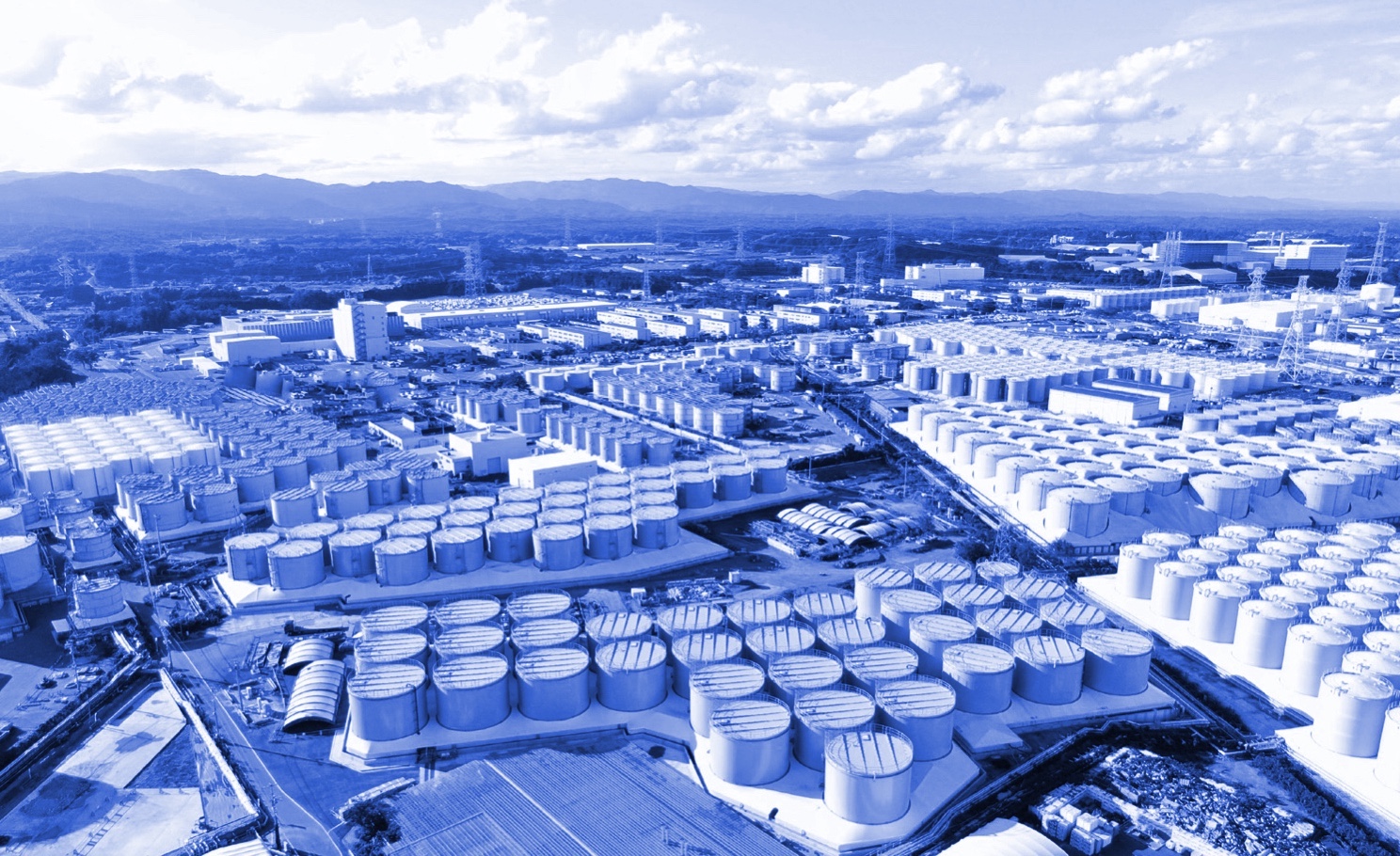
The official messaging that only tritium will remain in the water upon release has been very effective so far in shaping public opinion, but has been inadequate to gain trust. TEPCO and the Japanese government have focussed public attention and discussion on tritium without comprehensively responding to valid questions about the remnant radioisotope composition of the water post-treatment. It’s classic misdirection through repetition, which has been criticized by Safecast as well as by many researchers. Although TEPCO successfully hid the fact for years, in August, 2018 it became known that in addition to tritium, 70% of the tanks also contain water with high above-limit levels of other radionuclides of concern which ALPS had failed to remove, including Strontium-90, Ruthenium-106, Carbon-14, Technicium-99, and Iodine-129. The Pacific Islands Forum (PIF) Expert Committee in particular called in vain for a complete inventory to be made, before the releases were approved, of what radionuclides are in the tanks in what quantities. They justifiably noted that even in small quantities their effects will need to be monitored over a long period of time, particularly those that will accumulate in seafloor sediments
In fact, TEPCO has not conducted a thorough radiation sampling survey of the water tanks, and has released only very incomplete data. The Japanese government insists that, “Analysis of all nuclides in the water currently stored in all tanks, as requested by the PIF experts, is not required by the IAEA safety standards.”In other words, it wasn’t done because it’s not strictly required. Although adequately conducting such a survey would be challenging, we think it would greatly improve trust and public understanding, and there’s still time to implement it. The IAEA task force accepted that adequate risk estimates could be produced by theoretical “deskwork” analyses instead, and it’s true that this is commonly done. The task force also accepts TEPCO’s assurances that it would be able to successfully reprocess the water through ALPS to reduce these other radionuclides to the point that they could be easily diluted to 1/100 of the regulatory limits consistently over the 40 years or more the releases are expected to require. Without hard evidence, though, how will we know for certain?
Evidence of other problems:
We’re not arguing that these other radionuclides pose such a great risk under the current release plan that it should be stopped on that basis. But their undeniable presence can’t be waved away. Crucially, ample sampling data showing the current radionuclide content of the tanks will be essential for demonstrating that the ALPS system is operating with efficacy in the future. There’s no other truly accurate way to compare “before” and “after” treatment. If a full radionuclide inventory is somehow infeasible, then at the very least a more representative sampling program is called for.
The presence of this isotope “cocktail” also should have put to rest the loudly trumpeted claim that the planned discharges should be considered “normal” or “routine.” These nuclides are not present in ocean discharges from nuclear facilities that release tritium as part of planned operation. The cooling water at Fukushima Daiichi water is exposed to highly radioactive fuel debris inside the damaged reactors, and that’s why these other radionuclides are present. No matter how it might be officially designated, this is an emergency release of contaminated water, and nothing is normal about it.
Dose estimates:
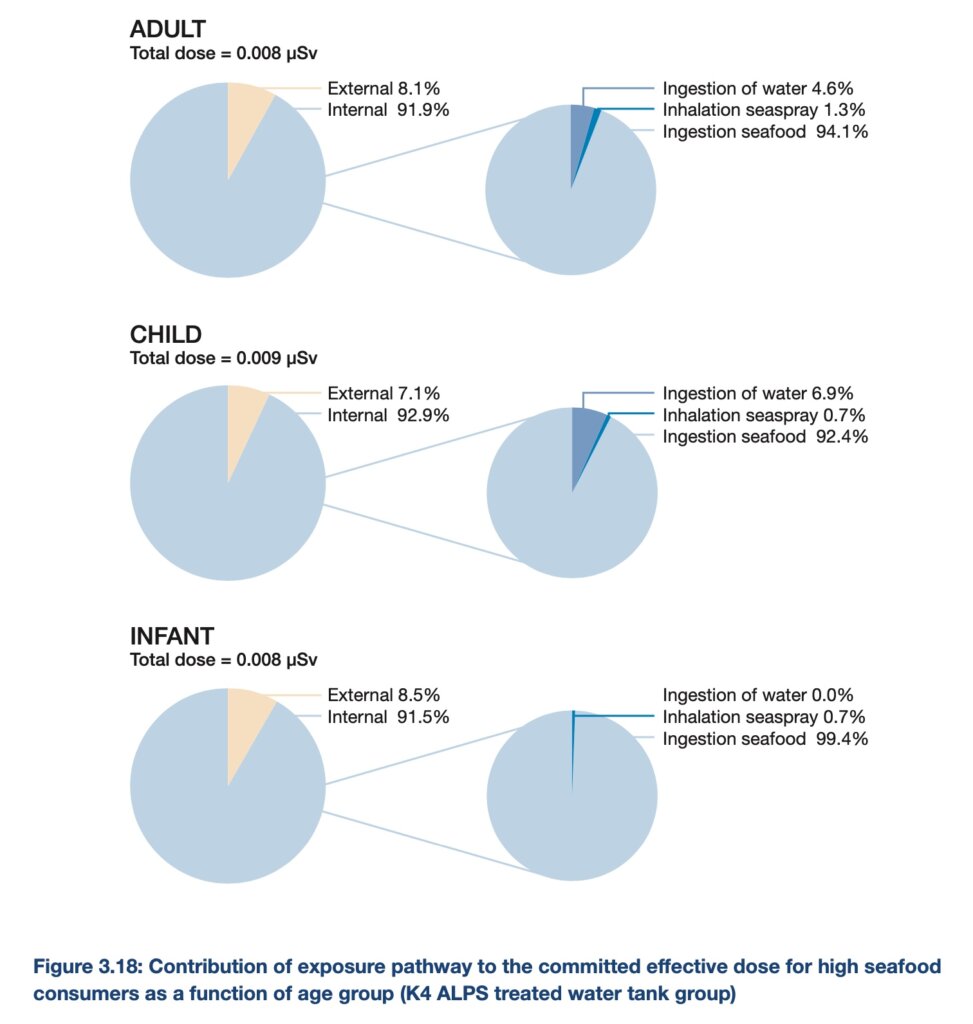
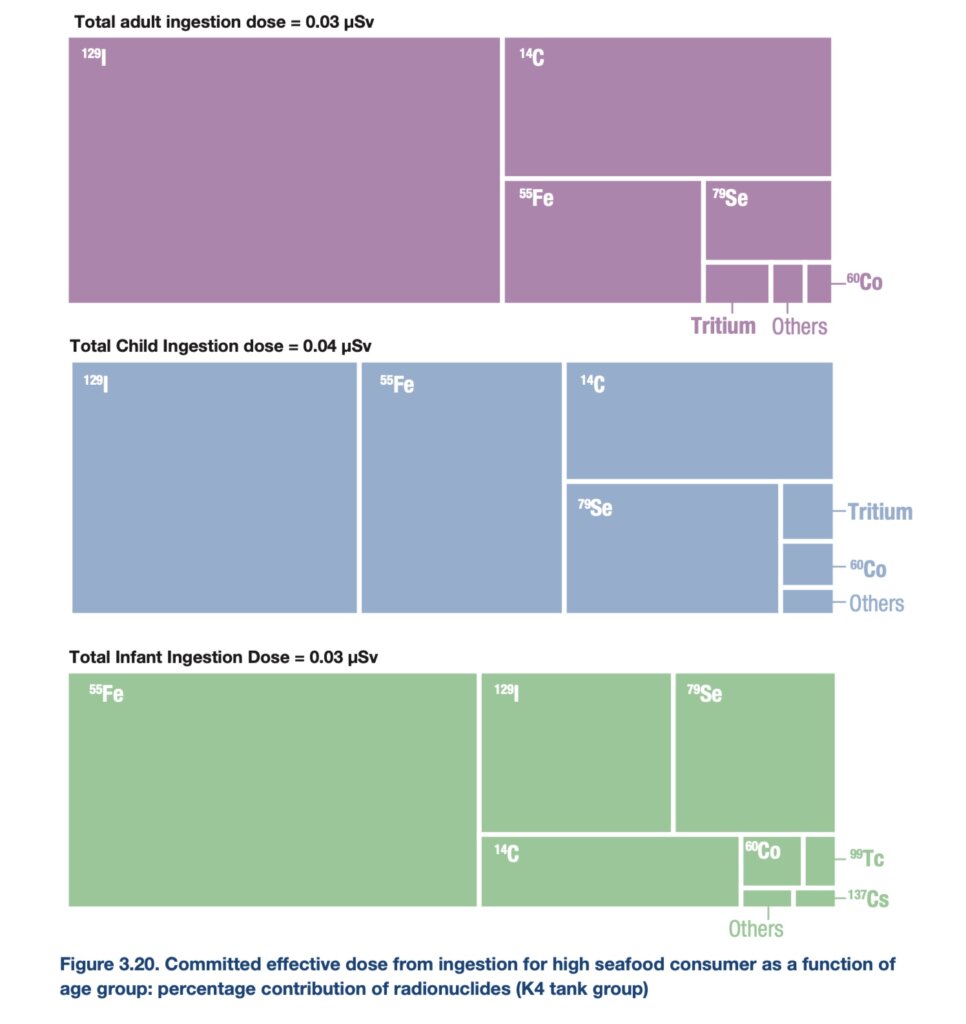
At the IAEA’s urging, TEPCO revised its dose estimates using a more realistic “source term” – the total amount of radionuclides to be released and their varieties – as well as improved modeling of likely human behavior near the release site. The resulting dose estimates are very low, less than 0.01 µSv/yr, even for the people who eat an above-average quantity of local fish and inadvertently gulp a lot of seawater while swimming. The reports note that internal exposures like these will account for slightly more than 90% of the total dose. They also note that the dose contributions from several radionuclides, notably Carbon 14, Iodine 129, and Iron 55, will be higher than that from tritium, which “…contributes no more than a few percent of the total committed effective dose.”
It may seem counterintuitive, and the science is a bit complex, but although the total radioactivity of the tritium released will be many times greater, these other remaining nuclides behave differently in the environment and are taken into the food chain differently. Even after dilution they present a higher risk factor. These risks needn’t be overstated, but the task force recommended to TEPCO that these radionuclides be clearly given allowable limits and included in public information, which they have not been until now.
The IAEA task force Comprehensive Report is very very clear about its own limited scope, and makes it clear that the responsibility for ensuring that TEPCO doesn’t endanger the public lies entirely with Japan’s nuclear regulator, the NRA. The IAEA can only offer non-binding advice. TEPCO and the Japanese government hope that the public will interpret the IAEA’s supportive conclusions to mean that the task force closely evaluated every relevant aspect and deemed it all good. But this is not the case. The IAEA’s reports note a number of issues central to the decision to release the water that are exclusively within the purview of the Japanese government, and which the IAEA could not criticize even if its experts disagreed. These include possible alternatives, and the overall “justification” for the releases and its many ethical aspects – whether the benefit outweighs the harm. We believe that it’s clear that the releases will harm fisheries communities financially, culturally, and psychologically due to lost livelihood, while the primary benefit will be to TEPCO. Yes, in terms of risks from further water-related disaster potentially averted down the road, there may be notable public benefit. The IAEA report also acknowledges that social factors, such as economic damage, are important, but explains that it was not empowered to take them into account. Many of the most knowledgeable observers point out that the Fukushima situation requires more compassionate action that truly addresses the plight of affected communities.
A fig leaf where trust is needed
The Japanese government invited the IAEA to review TEPCO’s plans in the hopes it would provide a convenient fig leaf for what they intended to do all along. The agency’s scientists did a lot of hard analysis, and seem to have pushed back very energetically in private. But the Japanese government and TEPCO quickly found ways to use the IAEA’s reports to reject even well-founded expert criticism and requests for information. This is frustrating to observe. People often want the IAEA to be something it isn’t, but we think the agency has been too ambiguous in its criticisms of TEPCO’s plans, particularly regarding long-term oversight. The release plan, though, is entirely the responsibility of TEPCO and Japan’s NRA, and the key decisions are their own political ones.
Japanese organizational culture is characterized by “sontaku,” in which individuals base their actions on what they secretly think will please their superiors, rather than a sincere appraisal of their own ethical responsibilities. Those who raise inconvenient questions are likely to be punished for it, even if they are correct, and there is no career benefit to doing anything that is not absolutely required. Over the years we’ve detected signs of this toxic dynamic in every aspect of the water release plan, and it has led to the accountability quagmire that envelops the plan even before the actual releases have begun.
Regardless of these challenges, Safecast will continue push for a more inclusive oversight regime to be established in the name of trust and transparency, and will continue to inform and educate the public about how this can be achieved.
SAFECAST publications re: Fukushima water issue:
No Trust Without Transparency: Safecast Special Report, May 20, 2021
Fukushima water discharge plan sets a dangerous precedent; Japan Times, April 25, 2021:
Radioactive water at Fukushima Daiichi: What should be done?(2 parts) June 5, 2018:
About that tritiated water: Who will decide and when? Japan Times, June 5, 2018: