Oct 21, 2026 · Written by Kelsie Stewart
On September 26, 2026, 16 high school students in Koriyama (Fukushima, Japan) spent an afternoon with Safecast. They learned why ordinary people started measuring radiation after 3.11, then went out and measured around their own school using the gGeigie Zen.
Fifteen years after the disaster, today’s high schoolers were either toddlers or not yet born. Hara-sensei (Asaka High School physics teacher) asked us to tell them what this work has been and why it mattered, not only then but also now. Beyond the history of the hardware of Safecast or the data platform we have built over 15 years, we made the case for one idea: citizens can measure for themselves and this leads to trust, a rare commodity in today’s world.
By the end of the day, the students had shared their data with the world and filled 33 sticky notes with sharp, honest questions.
At a glance
| Date | Saturday, September 26, 2026, 13:30 to 17:00 |
| Place | Fukushima Prefectural Asaka High School, Koriyama City, Fukushima |
| Students | 16 total: 10 from Asaka High School, 6 from Asaka Reimei High School |
| Teachers | Hara-sensei and Hirayama-sensei (Asaka High School), Chiba-sensei (Asaka Reimei High School) |
| Safecast | Pieter Franken, Kelsie Stewart, Paul Yeh |
| Also joining | 3 members of the Radiation Safety Support Center (Iwaki City) |
| Program | Part of Asaka High School’s Super Science High School (SSH) program |
How the afternoon unfolded
The workshop moved from what students already knew, to Safecast’s story, to measuring, to talking it all through.
- 13:30 Welcome. Kelsie opened the session and introduced the Safecast team.
- 13:40 Warm-up with sticky notes. Kelsie put a handful of keywords on the screen: IoT, fake news, open data, the nuclear accident and more. Students spent about 10 minutes writing what they knew or noticed, then several shared their thoughts with the room.
- 14:00 The Safecast story. Pieter told how volunteers built their own radiation monitors after the Fukushima Daiichi accident. He traced the bGeigie from its first version to the new bGeigie Zen, then covered open data, citizen science, and Safecast’s volunteers around the world.
- 14:25 Citizen science in Taiwan. Paul shared how Safecast and citizen science work in Taiwan.
- 14:40 Out to measure. Three groups took bGeigies and bGeigie Zens around the school grounds, with Kelsie, Pieter, and Paul walking alongside.
- 15:00 Data goes public. The groups uploaded their readings to the Safecast system, adding their school to the open map.
- 15:30 Wrap up. Students from both schools gave their “furikaeri” (reflections) about what they learned and how they will apply it to their own life.
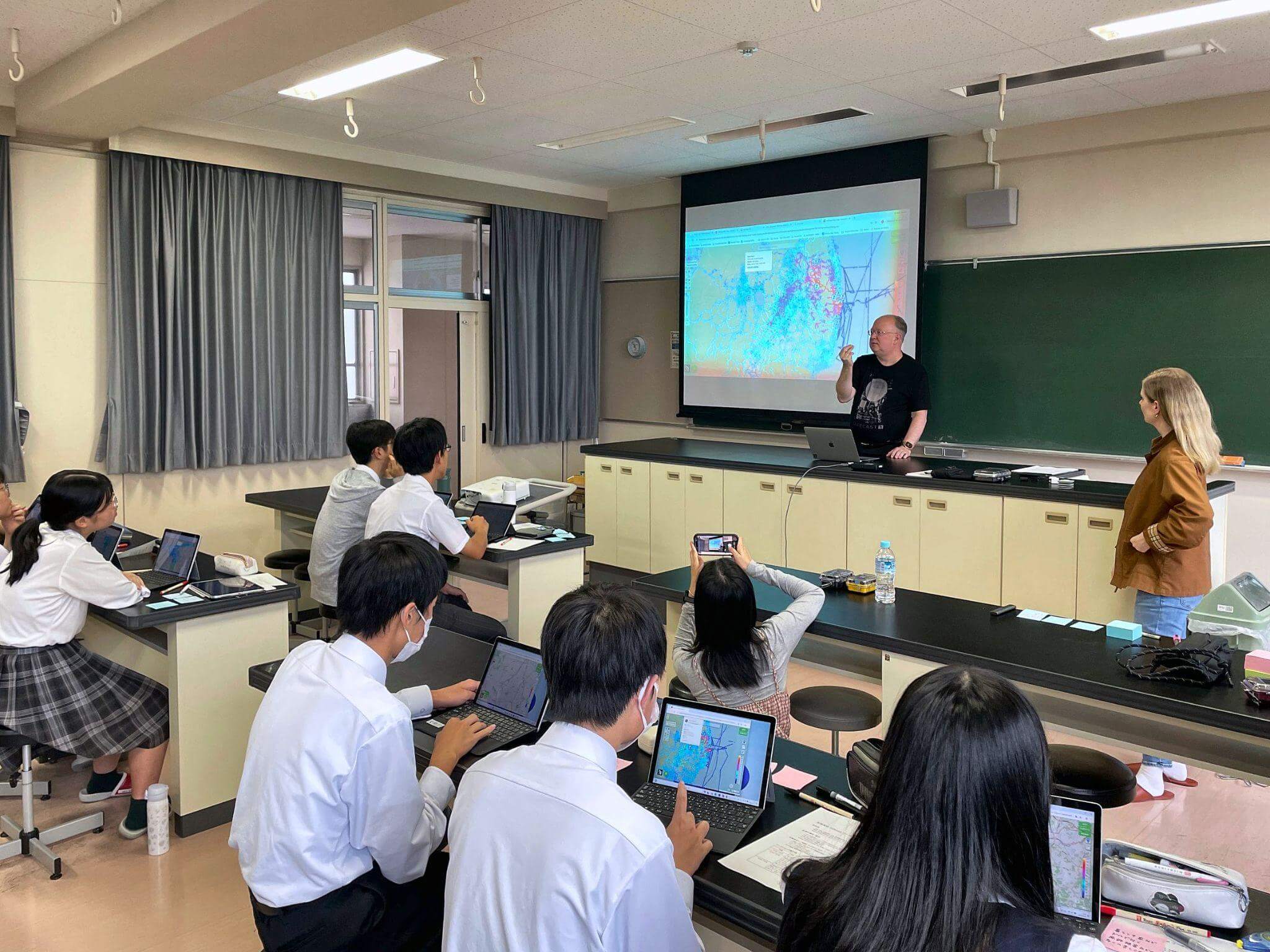
Pieter Franken tells the Safecast story, from volunteers building their own radiation monitors after the Fukushima Daiichi accident to today’s open map, as students follow along on their own devices.
What the students wrote
The 33 sticky notes from the warm-up show students who are curious, a little skeptical, and already thinking like citizen scientists. Here are the big themes, in the students’ own words (translated from Japanese).
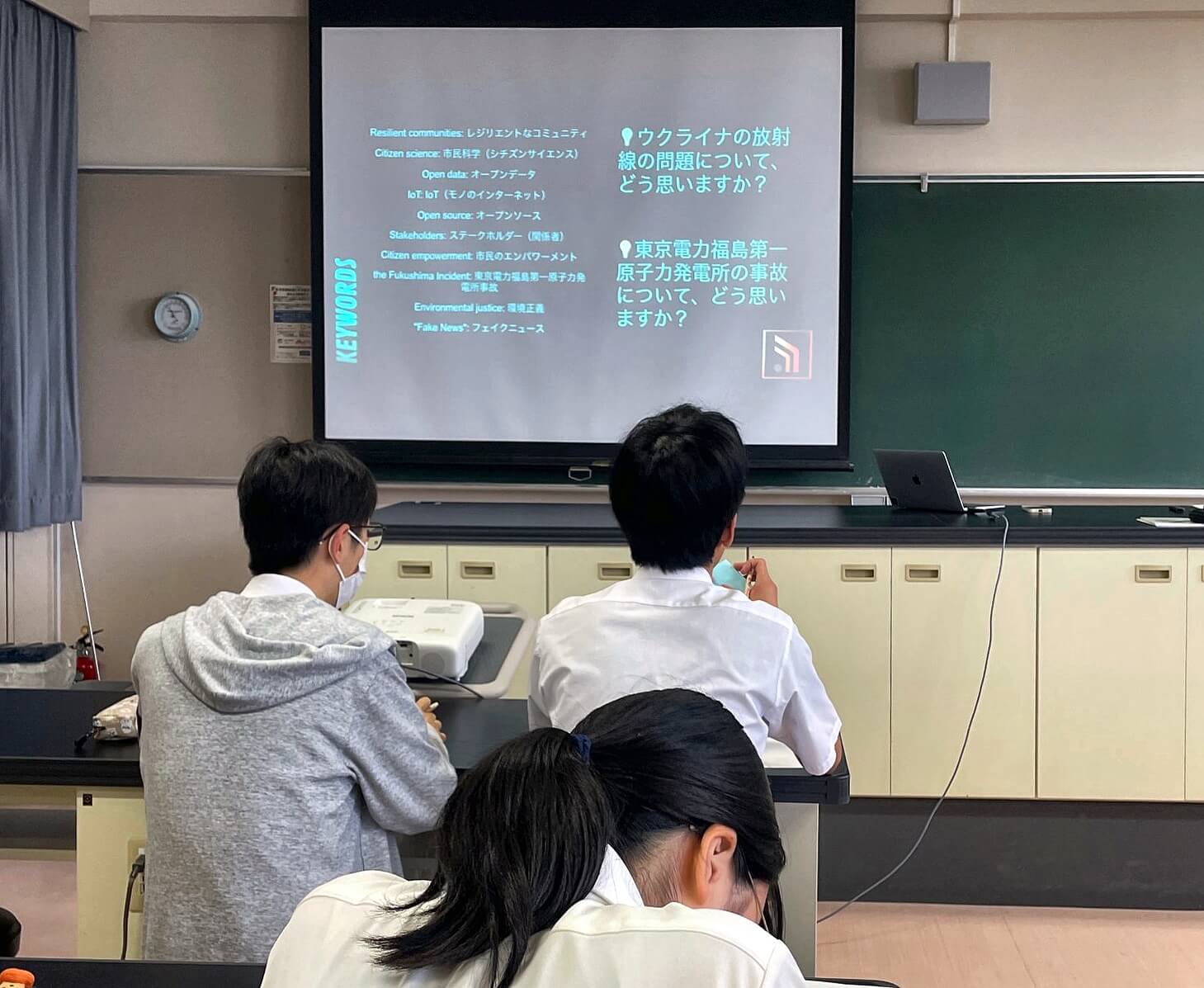
The warm-up slide: keywords from “citizen science” and “open data” to “environmental justice” and “fake news,” with two opening questions. What do you think about the radiation problem in Ukraine? What do you think about the TEPCO Fukushima Daiichi accident?
“Should we trust it at first glance?”
Fake news was on everyone’s mind, and so was AI.
“Should we trust unsupported information at first glance? AI sometimes gives you unsupported stuff too.”
“To avoid believing fake AI-made videos, we need to check where information comes from.”
“Fake news: What kind of people try to spread it?”
One student went a step further and asked how to protect ourselves from our own brains:
“When schools teach disaster response, it’s important to explain which psychological effects tend to kick in, so people don’t believe false rumors without realizing it.”
“Will future generations even know this happened?”
These students have no memory of 3.11, and they know it.
“To finish decommissioning by 2050, we need more than better technology. Many people also need to know about it. That’s right around when our generation starts working.”
This note really surprised the Safecast team. The cleanup isn’t history to these students. They understand that it’s their future job.
Fear, facts, and fairness
Many notes wrestled with fuhyo higai, the reputational damage Fukushima has faced from rumors and fear.
“Understanding the dangers of radiation matters. Still, I think it’s best to get accurate knowledge and be only as cautious as needed.”
“Does reputational damage happen because people don’t know about radiation?”
“Textbooks sometimes mention the nuclear accident. Schools should also teach that there was slander and what misunderstandings came up.”
Others named the human cost directly: prejudice against evacuees, and the sadness of people who still can’t go home.
“What counts as recovery?”
“We say ‘recovery,’ but what counts as recovery? What can we do to help with that?”
“When the people who use nuclear power are different from the people who live where it’s produced, gaps appear in how they see it and use it.”
That second note even labeled itself “stakeholders.” It names something adults often miss: Fukushima’s plant powered Tokyo, not Fukushima.
Looking beyond Japan
Several students connected Fukushima to Chernobyl and the war in Ukraine. Some admitted they didn’t know Ukraine had radiation issues at all. Others worried that Russia’s occupation of the Chernobyl plant spreads a distorted image of radiation.
“Open data? What’s it for?”
One honest note said, “I don’t know what open data can be used for.” Another student remembered learning it in IT class and wrote simply, “Important.” By mid-afternoon, they had seen one answer: their own readings, on a public map, for anyone to use.
Out with the bGeigies
The hands-on part was the clear highlight. Three groups headed out with bGeigies and the new bGeigie Zen. They measured the school building, the courtyard, the stairwells, and the planted areas around the grounds.
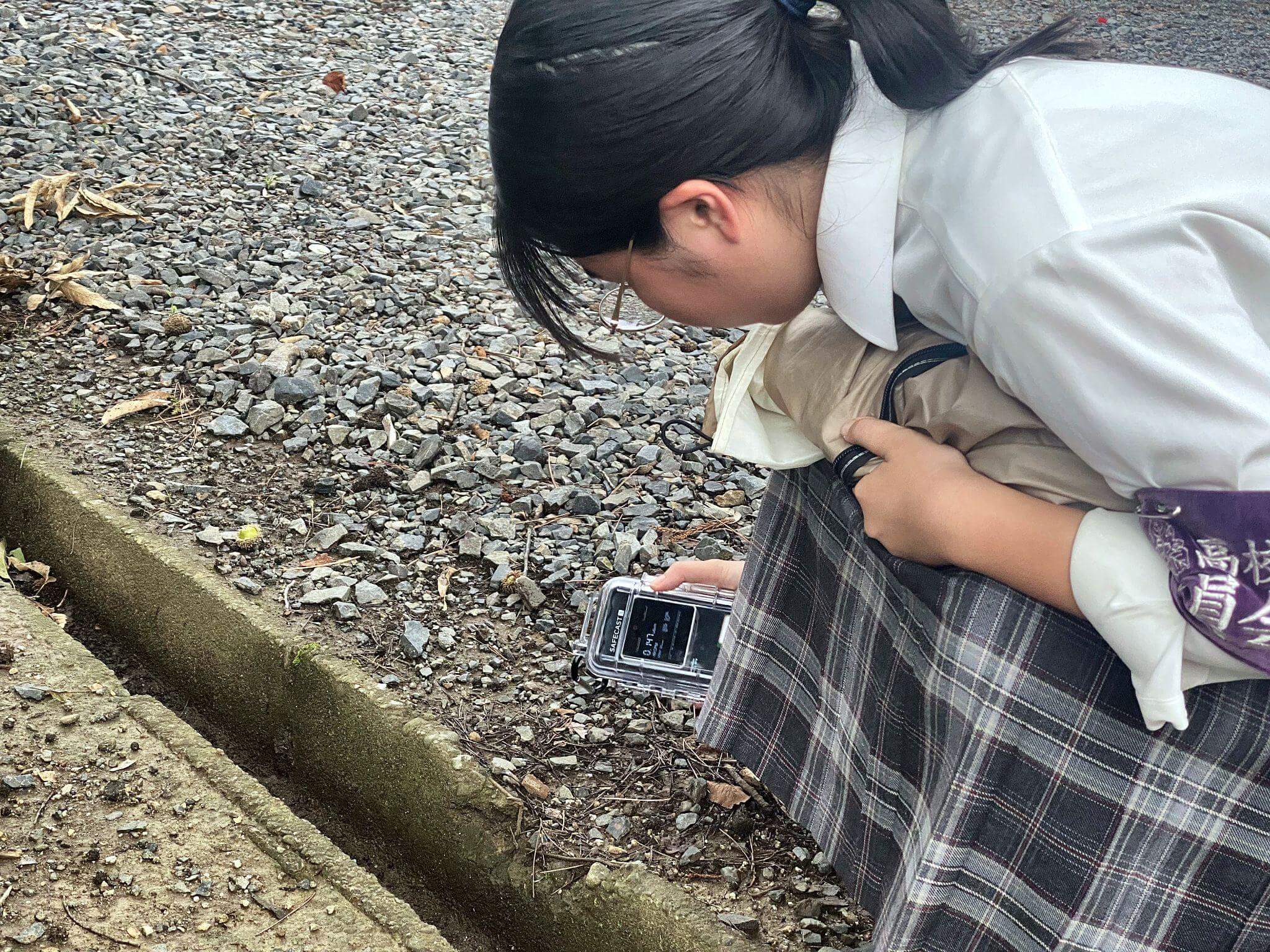
A student checks her bGeigie Zen reading beside a drainage gutter on the school grounds.
Some readings surprised them. As one student put it in the survey: “Measuring the radiation levels at school was fun. Levels were higher in some unexpected places, and that made me more interested in radiation.”
Back inside, the groups uploaded their data to the Safecast system. Their school is now part of the same open map that volunteers have been building since 2011.
What the survey said
The schools ran a survey after the workshop, and 11 students responded. The standout: all 11 said their sense of active citizenship grew, and 7 said it grew a lot. That’s exactly the point we came to make.
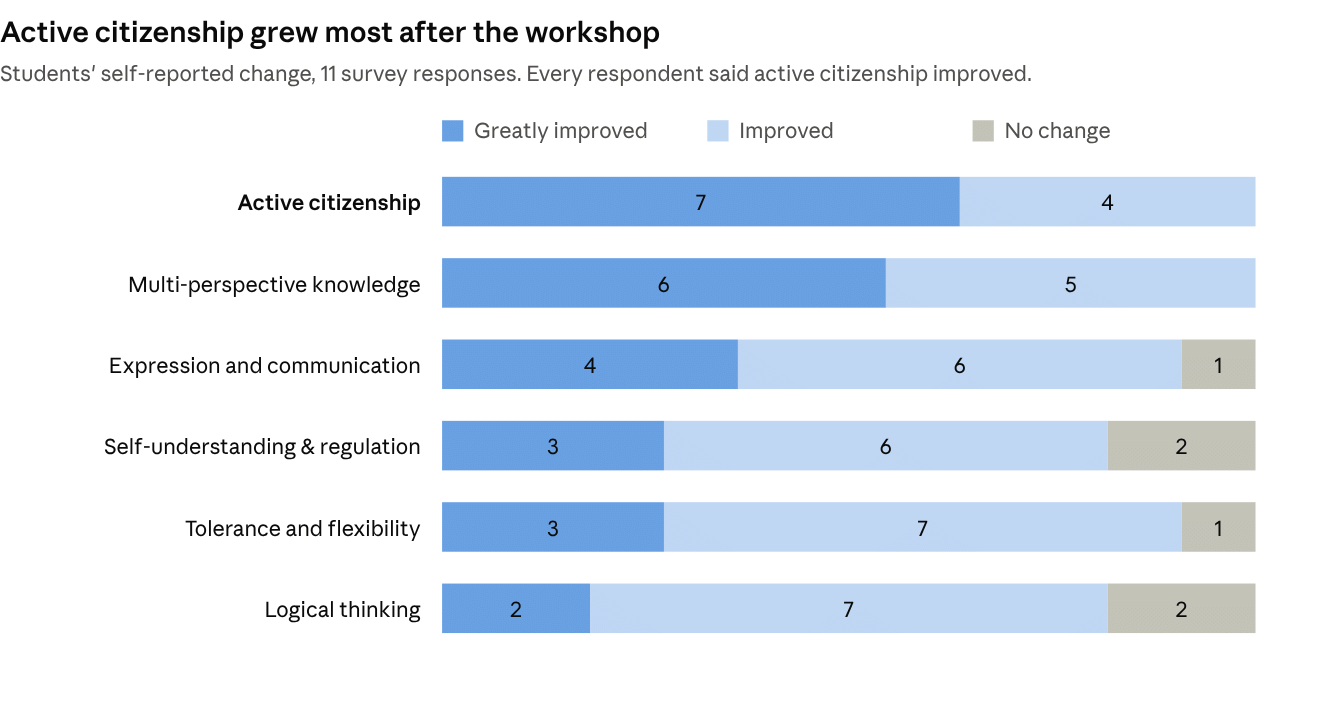
Asaka High School post-workshop student survey · 11 responses (6 Asaka, 5 Asaka Reimei)
The written answers were even better. A few favorites:
“My mother told me that right after the accident there was so little information about radiation levels that she acted carelessly, and she regrets it. With Safecast’s open data, people can get reliable information even in fear and confusion.”
“In a disaster, we shouldn’t rely too much on experts or the government. It’s important to gather information ourselves. Through citizen science like this, I want to avoid being fooled by false facts, even in the age of AI.”
“I learned that ordinary citizens can make the world better if they take action.”
“Measuring radiation at my own school and sharing it as open data made me feel I was contributing to people’s safety and peace of mind.”
Paul’s Taiwan talk left a mark too. One student loved the attitude of seeing a need and saying, “Let’s build a website for that!”, and noted it works because people trust each other enough to collaborate. Several were amazed that Safecast runs on volunteers, not paid staff.
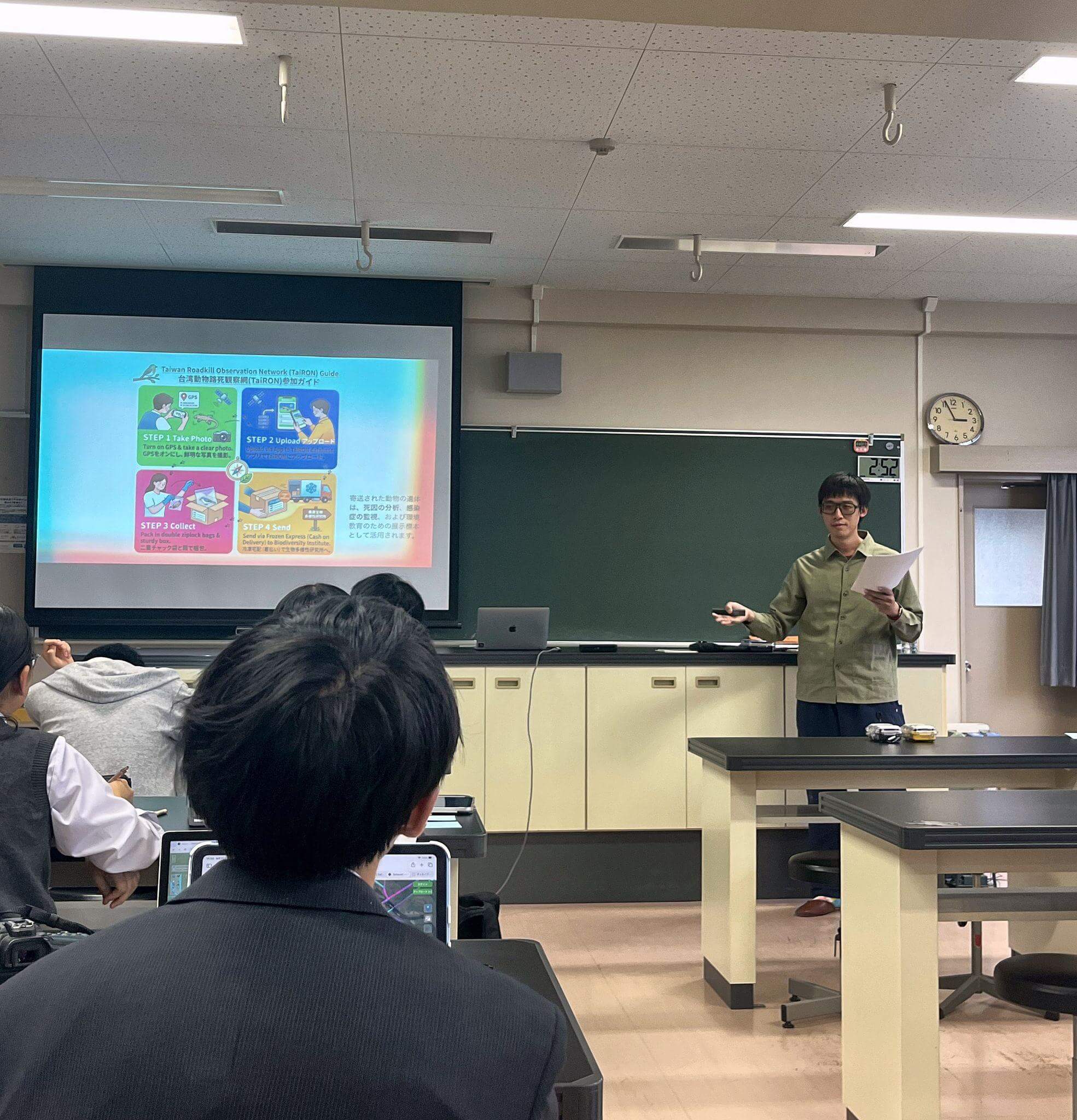
Paul Yeh shares citizen science from Taiwan, including a nationwide roadkill observation network built entirely on public participation.
What they want next time: to build their own radiation monitor. Two students asked for it directly (“I hope we can assemble one next time!”), and another suggested holding more of these sessions.
In the news
Two Fukushima newspapers covered the workshop.
| Paper | Date | Headline | What they highlighted |
|---|---|---|---|
| Fukushima Minyu (福島民友) | October 17, 2026 | 民間復興支援 学び深化 (“Learning deepens on citizen-led recovery support”) | Safecast’s story of building its own monitors after the TEPCO Fukushima Daiichi accident, the idea of citizen science, and students walking the school and courtyard to upload readings online |
| Fukushima Minpo (福島民報) | October 18, 2026 | 放射線測定や市民科学を学ぶ (“Learning about radiation measurement and citizen science”) | The development of the bGeigie, groups measuring inside and outside the school and registering data with Safecast, and the student exchange on regenerated soil and Fukushima’s recovery |
Both papers noted that the workshop was part of Asaka High School’s Super Science High School (SSH) program, designated by Japan’s Ministry of Education.
What we’re taking home
We came to explain why citizens measure for themselves. The students got there on their own, and then pushed further than we expected.
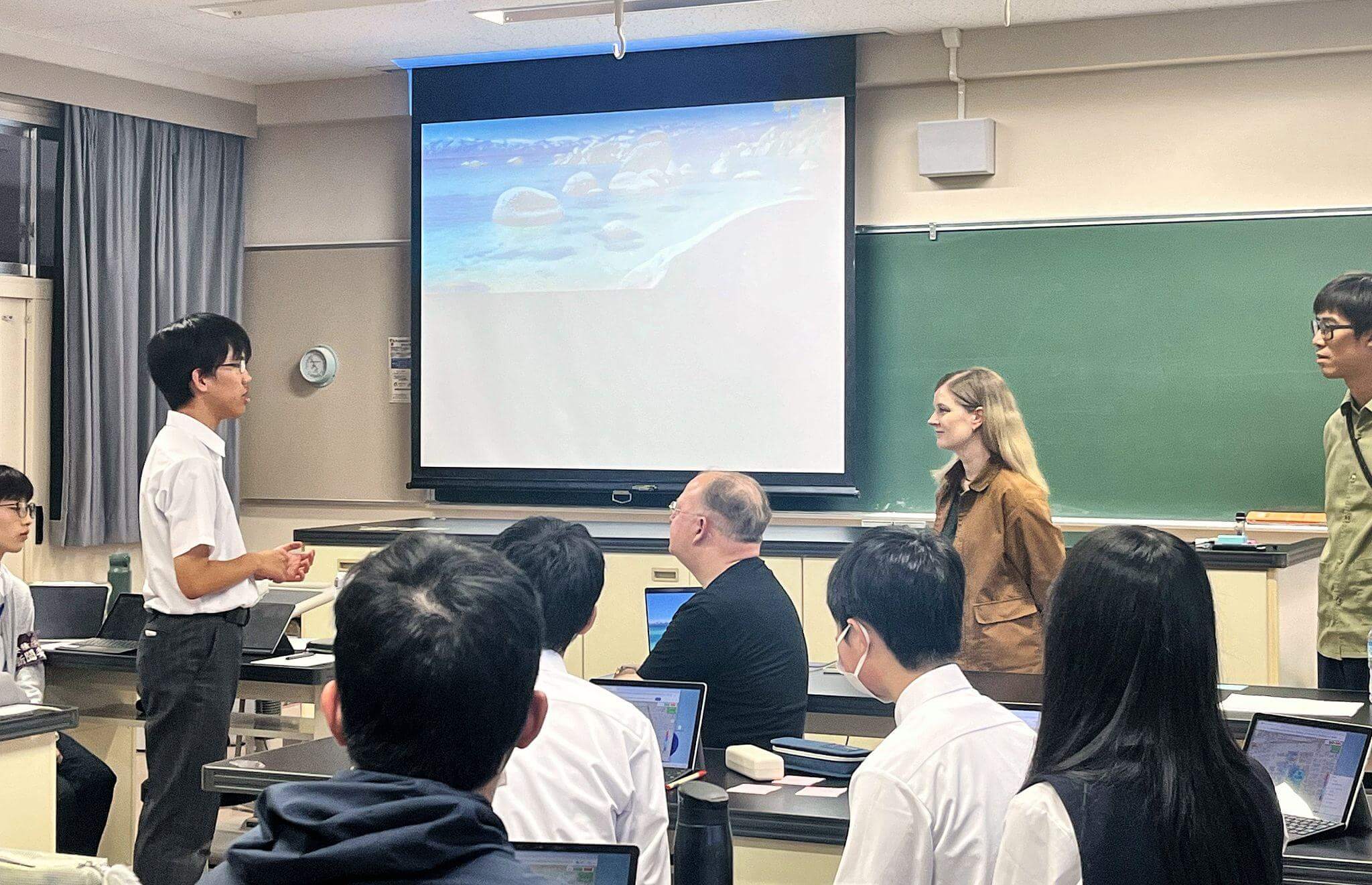
A student shares his furikaeri (reflections) with the room, as Pieter, Kelsie, and Paul listen.
Students from both schools share their furikaeri (reflections) at the end of the afternoon.
- The memory gap is real, and the students feel it. “Will future generations even know this happened?” isn’t our question as Safecast anymore. It’s theirs and somehow the new generation affected by it the most is feeling it.
- Misinformation is their native problem. For this generation, Safecast’s story fits right next to AI-generated video and fake news problems. Checking the source is a skill they already value and are curious to get better at.
- Hands-on beats slides. Measuring their own school made radiation real. Next year, let’s try what they asked for: building a bGeigie Zen together!
A big thank you to Hara-sensei, Hirayama-sensei, and Chiba-sensei for bringing two schools together. Thanks also to the Radiation Safety Support Center for joining us, and to all 16 students for their curiosity and their excellent sticky notes. We hope to see you on the map!
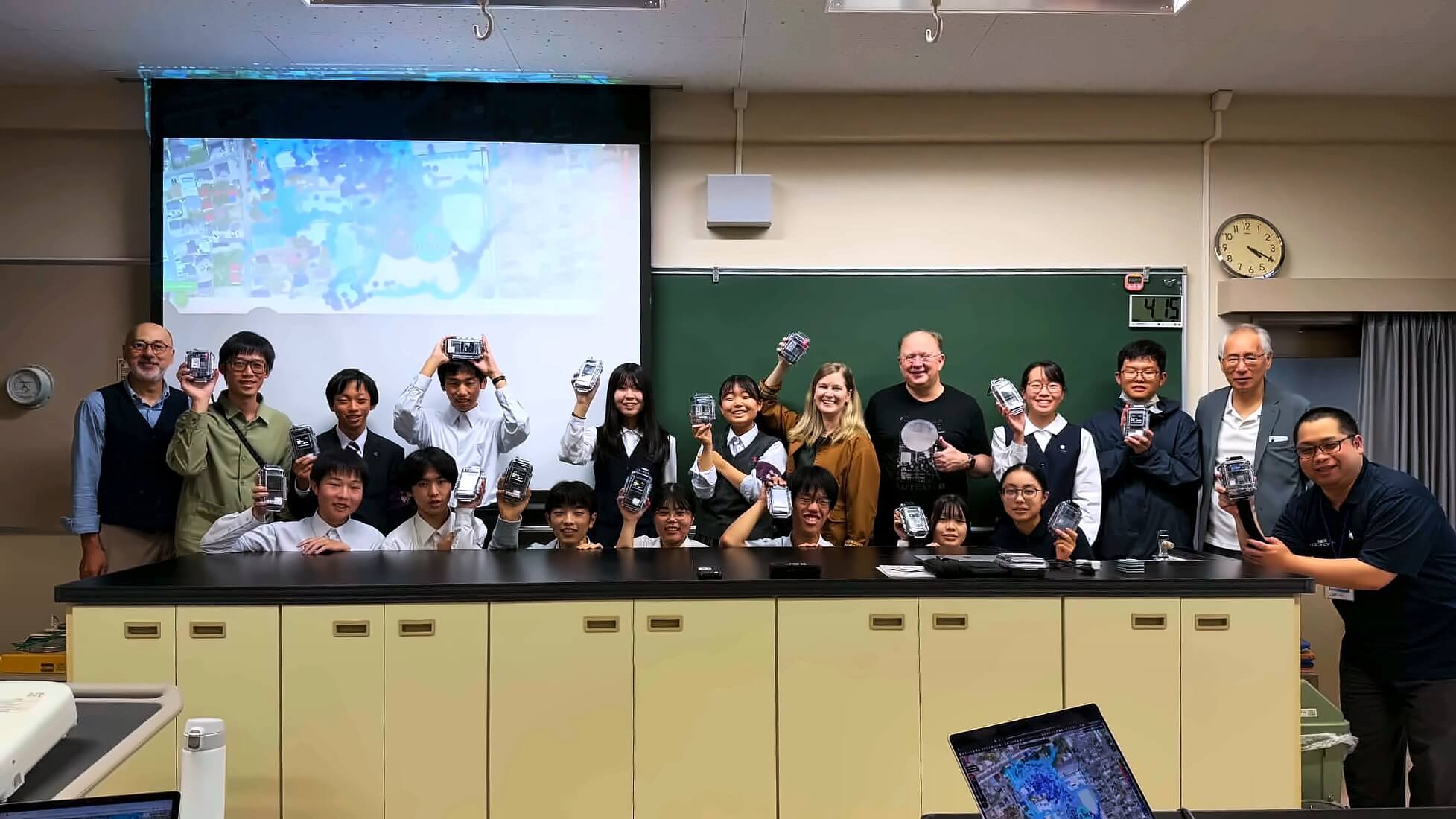
Students from Asaka High School and Asaka Reimei High School with the Safecast team, their teachers, and the Radiation Safety Support Center, holding up the bGeigies they measured with. Their tracks around the school are on the screen behind them.
Photos:https://drive.google.com/drive/folders/13Cg1wA0pEN5rj98F88rfbHwPYAPLaeZr?ths=true
Get involved!
Bring a workshop to your school or community. If you’d like to organize a Safecast workshop like this one, contact Kelsie at kelsie@safecast.com. We can adapt the program for different ages, group sizes, and goals.
Build your own bGeigie Zen. The students asked to build a monitor next time, and you can too. The bGeigie Zen assembly kit comes with everything you need to put it together and start adding your own measurements to the Safecast map.
Support Safecast. Safecast is run by volunteers, and every workshop, device, and data point depends on support from people like you. Donate here to help us keep measuring, sharing open data, and bringing citizen science to the next generation.