Over several months, five students from Minerva University worked on making the world’s largest citizen-collected radiation dataset even more accessible, intelligent, and useful.
The project covered the implementation of an AI assistant, an analytics pipeline, and more, with the aim of putting Safecast’s data in the hands of everyone from Fukushima researchers to first-time visitors who have never heard of a micro Sievert.
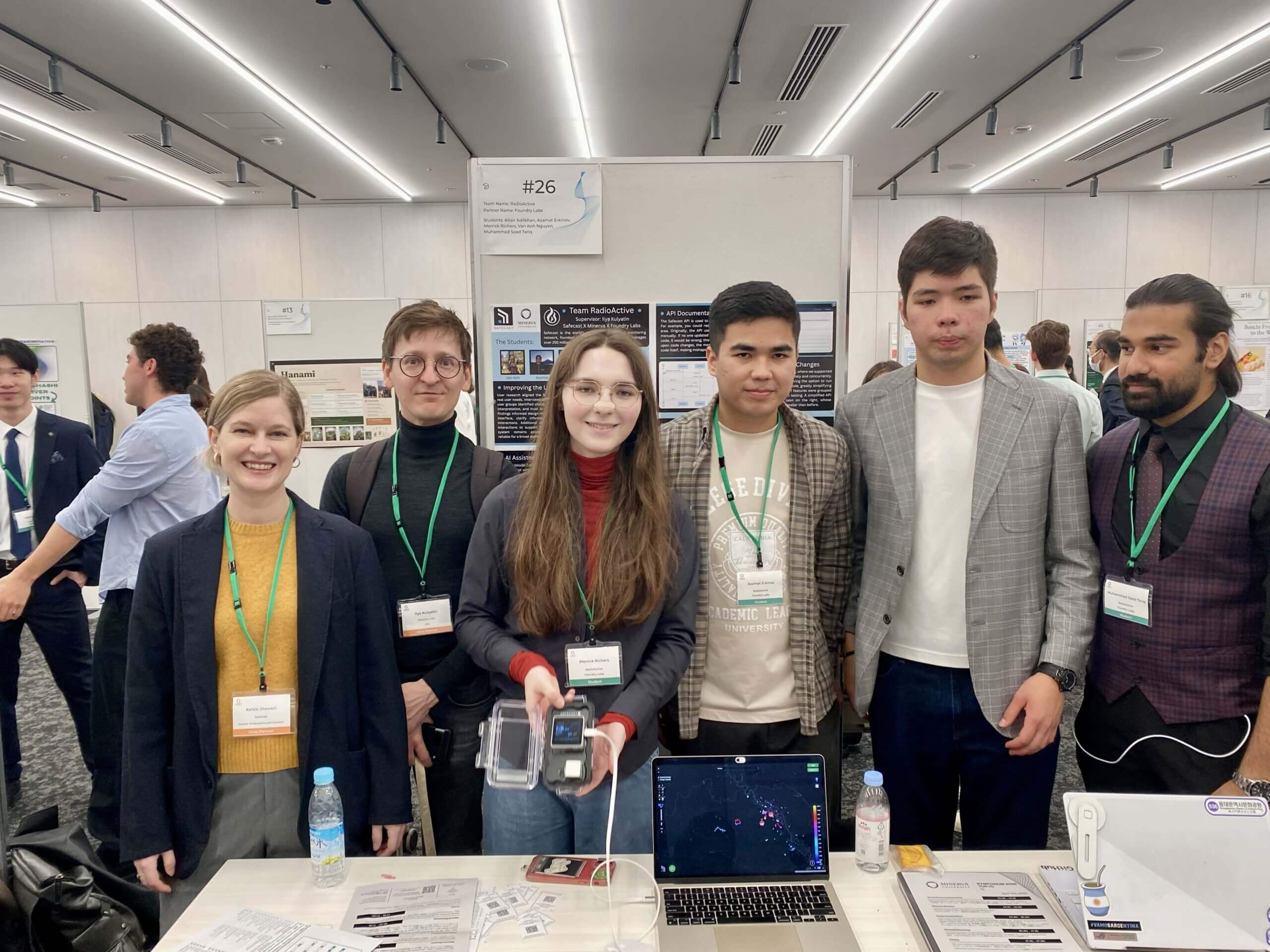
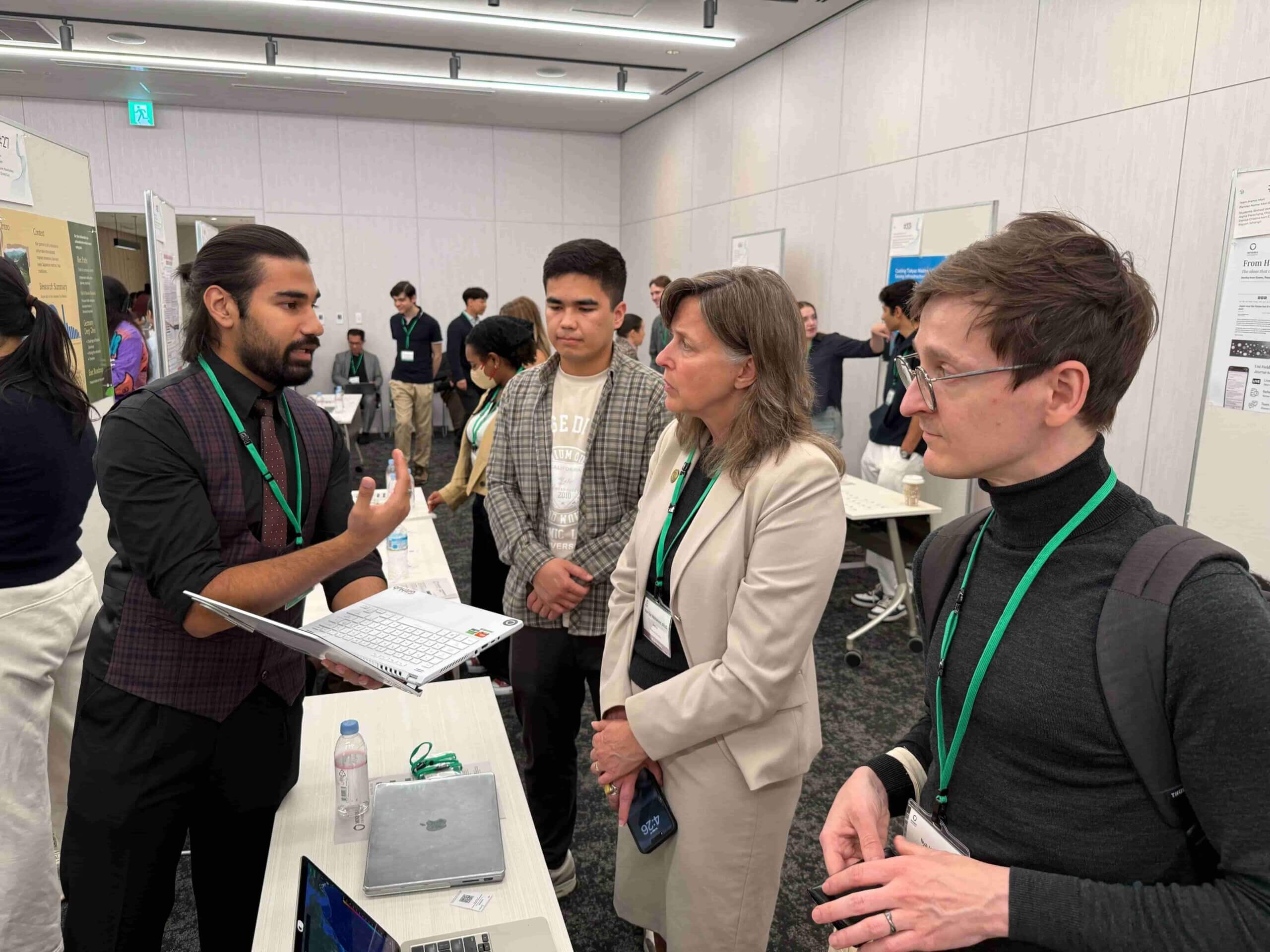
The project, carried out through Minerva’s civic internship program in partnership with Foundry Labs and Safecast, wrapped up with a public presentation at the Minerva University Tokyo Symposium 2026 at OIMACHI TRACKS in April, 2026.
The team
The five Minerva students taking part were Azamat Erkinov, Altair Adilkhan, Van Anh Nguyen, Muhammad Saad Tariq, and Merrick Richers. The group worked alongside Safecast’s team of Rob Oudendijk, Kelsie Stewart, and Azby Brown, supervised by Ilya Kulyatin at Foundry Labs.
Throughout the project, the students looked at various facets of the Safecast platform, including the potential for AI assistant integration, data analytics, user research, and API maintainability.
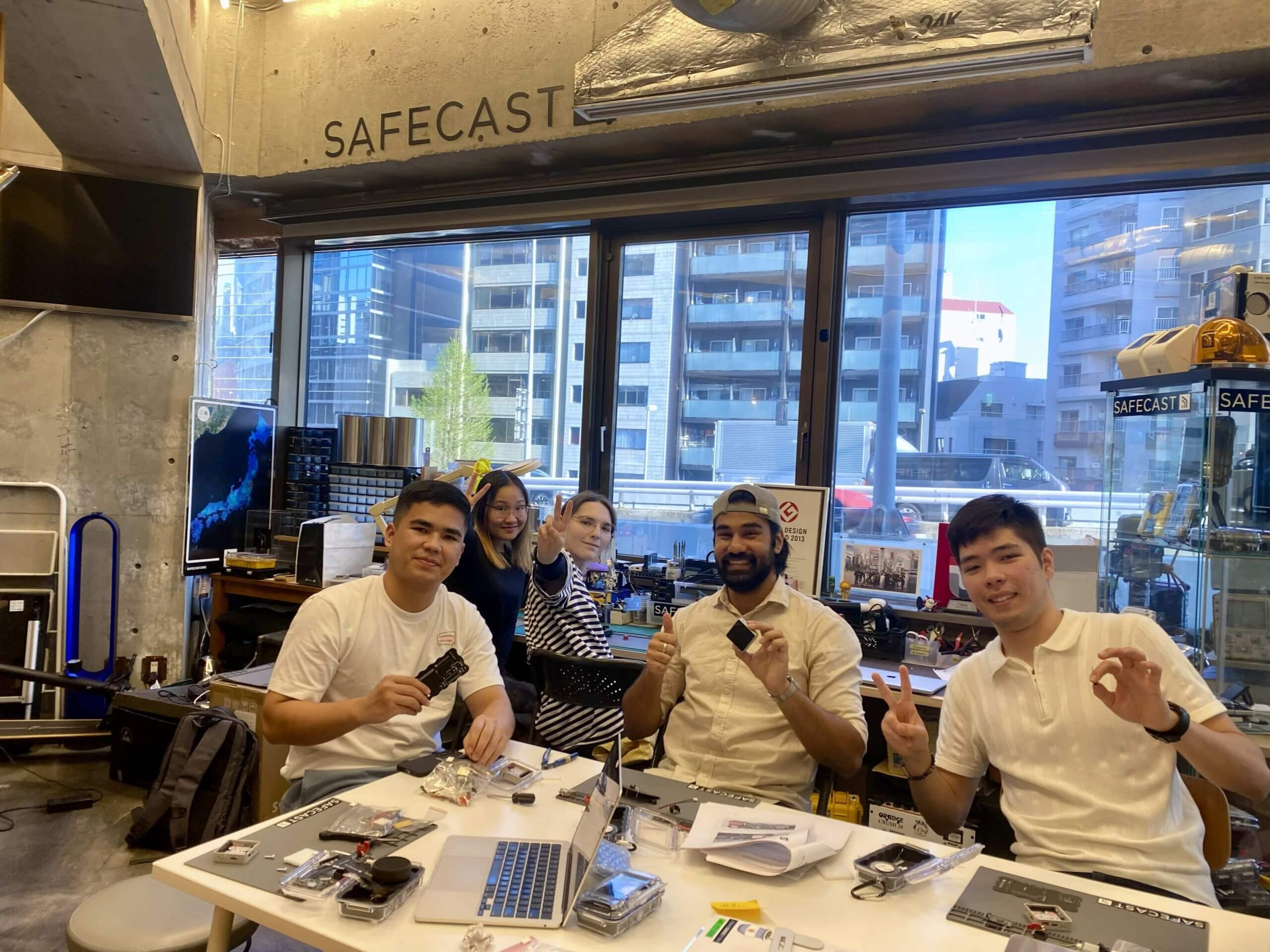
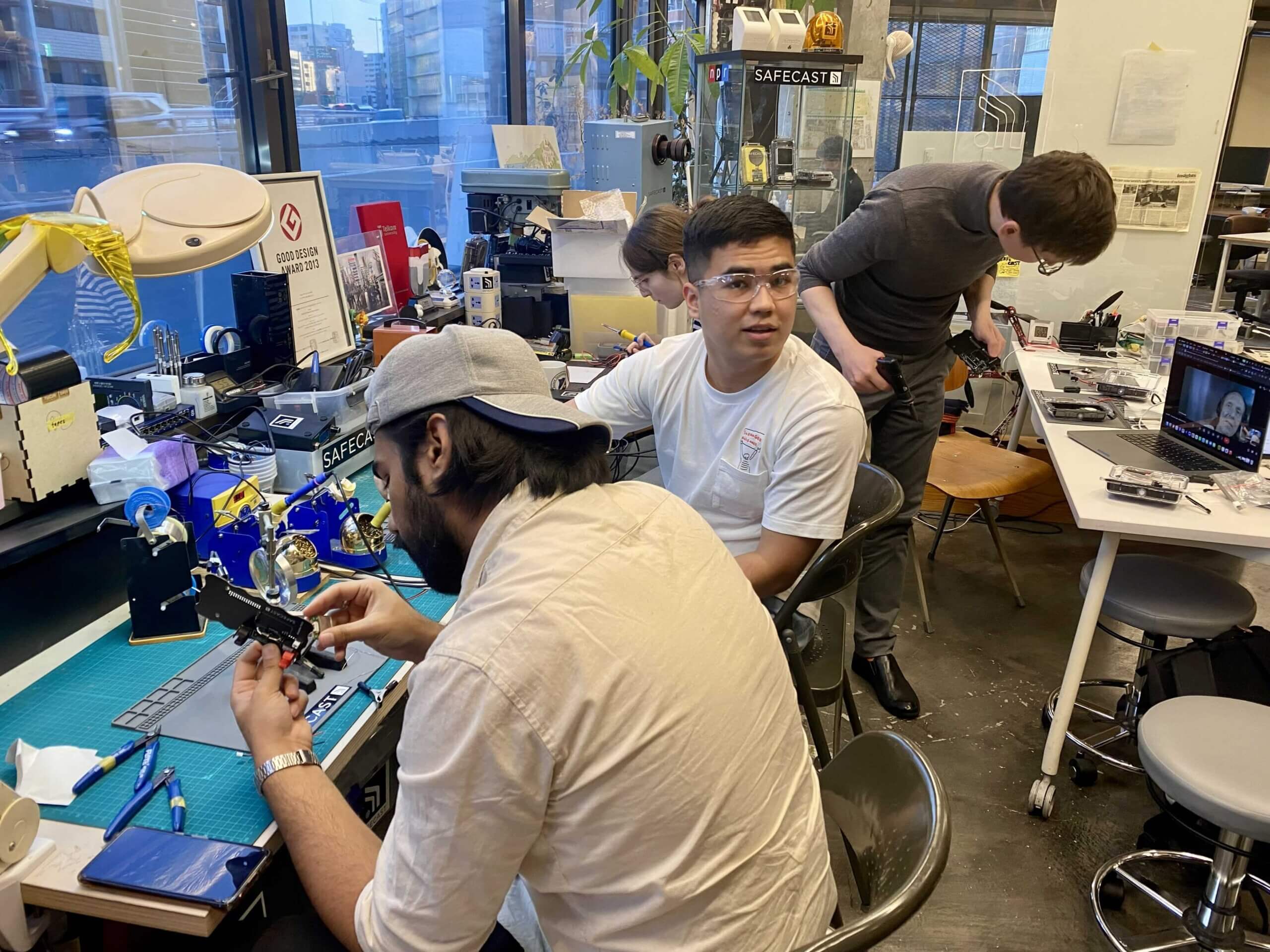
They collaborated over Slack and at the Safecast office in Tokyo, moving through a structured timeline from January’s kickoff through final deliverables in early April.
An AI assistant for the Map
One of the most visible outputs of the internship program is an AI assistant embedded directly into the Safecast map embedded directly into the interface of a revised Safecast map currently under development. Built by Azamat using the Model Context Protocol (MCP), the assistant lets users ask plain-language questions about things like radiation readings, specific locations, recent measurements, anomalies and receive contextual responses without having to interpret raw data on their own.
Development of the assistant underscored how difficult making an automated system that can provide factual, non-prescriptive responses and will avoid speculation can be. It can also be accessed as a standalone tool, separate from the map, for users who prefer a more direct interface.
A Fukushima analytics pipeline
Altair and Saad built a Python-based analytics pipeline that transforms raw Safecast measurements into interpretable outputs. Their work covered the full journey from data collection and moderation through spatial modeling, trend forecasting, and dashboard-ready visualizations.
Insights generated by their prototype include new analysis of several aspects of the Fukushima dataset.
When it came to predictive modeling, tree-based approaches, particularly Random Forest, consistently outperformed simpler linear models, suggesting that radiation patterns in the region contain genuine non-linear spatial and temporal structure.
Listening to the community
Van Anh led the team’s user research effort, which turned out to be one of the most insightful parts of the project. Working with Kelsie Stewart from the Safecast team, she designed and deployed a survey targeting Safecast’s existing community of contributors, researchers, educators, and curious members of the public.
The responses, drawn from participants across Japan, Europe, North America, and beyond, revealed a consistent theme: the map’s data is valuable, but the barrier to understanding it can seem high.
Respondents flagged radiation units and measurements as a common stumbling block, and many called for built-in explanations, guided exploration modes, and beginner-versus-advanced viewing options. Educators in particular, ranging from K–12 teachers to university researchers, expressed strong interest in classroom-ready resources, with several noting that the map’s potential as a teaching tool is currently underutilized.
Thanks to the work, a full IRB-reviewed research report is in progress and will inform future UX decisions.
The full survey invitation, shared with Safecast’s community, can be found here.
A more maintainable API
Merrick’s contribution will, for most, be the least visible – but arguably the most durable.
The existing Safecast API had grown to become a set of difficult-to-maintain files. This is a common problem in long-running open-source projects that accumulate technical debt over time.
After an initial plan to fully reimplement the deprecated API was reconsidered following a conversation with lead developer Rob Oudendijk, Merrick shifted focus to improving the maintainability of the API infrastructure already in place.
That meant reorganizing API handlers into dedicated, logically grouped files; implementing Swaggo, an automated documentation system that generates up-to-date API docs directly from the code; and introducing a PR template that prompts contributors to articulate what they changed, why, and how it was tested.
The result is a codebase that future contributors can actually navigate — and documentation that can’t silently fall out of date.
What comes next
After a successful symposium, several threads of work are continuing:
The analytics pipeline is being scaled from its Fukushima-focused prototype to handle the full 27 GB global Safecast dataset, with work underway on an interactive dashboard for location-based querying and visualization worldwide.
The AI assistant is being refined into a fully functional, polished prototype with implemented neutrality controls and tighter integration with Safecast’s modeling and API components.
User research findings are being analyzed by demographic and user type, with UX recommendations for both the map interface and the AI assistant to follow — feeding directly into Safecast’s product roadmap.
And on the API side, the plan is to finish isolating all endpoints to discrete folders, enforce Go best practices throughout, and introduce a lightweight observability layer tracking latency, errors, saturation, and traffic — with results displayed in a dashboard.
A note of appreciation
For Safecast, this project has been an amazing illustration of what is achievable when students, civic partners, and organizations engage in collaboration.
We’re grateful to Azamat, Altair, Van Anh, Saad, and Merrick for their time, their care, and their curiosity. And to Ilya, Rob, Kelsie, and Azby for making the partnership possible.
Interested in contributing to Safecast’s mission? Learn more at safecast.org